El Jet Lag y la melatonina
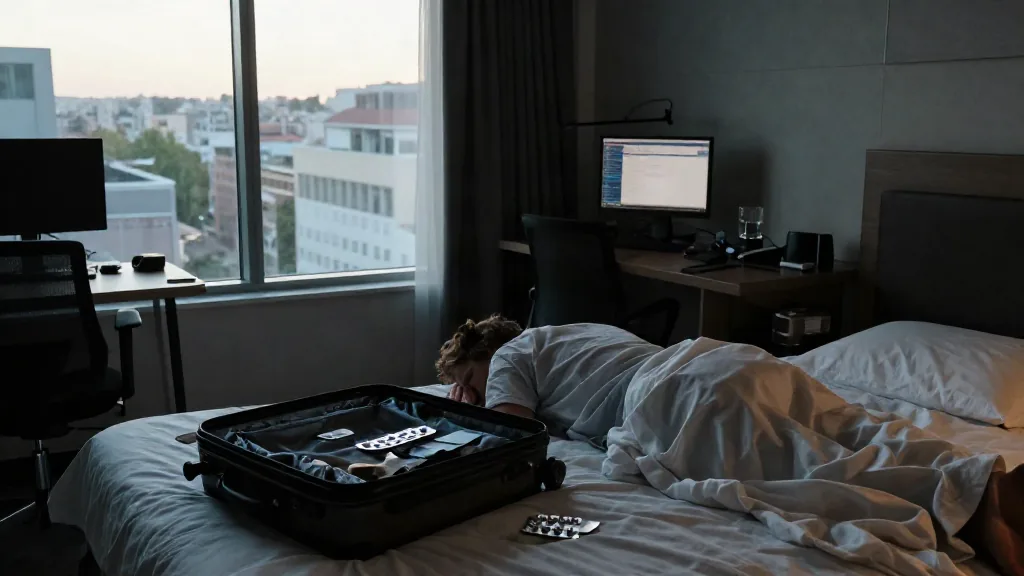
El Jet lag es algo para lo que el ser humano no esta preparado ya que no ha habido adaptacion para ello, y es muy perjudicial segun estudios:
A recent article in ScienceNow Daily News reported on the growing concern in the scientific community over the dangers of jet lag. Turns out it’s more serious than we previously realized. Jet lag increases risk of cancer, ulcers, and sleep disorders, as well as weakening the immune system.
Fuente: http://news.sciencemag.org/search/jetlag
Por otro lado tomar melatonina puede ayudar con ello, pero consumir hormonas siempre lleva a que el cuerpo deje de hacerlo de forma natural:
Melatonin is a hormone.
That’s right – a hormone. Like estrogen. Like testosterone. And just like taking estrogen (whether it’s Hormone Replacement Therapy or the Pill) or testosterone therapy, melatonin comes with risks. Frequent melatonin use – especially in the typical dosage of 3-6 milligrams – can trigger a bit of a vicious cycle in the brain. Supplement with melatonin regularly to get to sleep, and your body is going to produce even less, creating even greater need for the hormone. It’s not that you can’t ever take melatonin; but I think it’s important that people understand the facts.
Fuente: http://www.marksdailyapple.com/before-y … z3HENMXrsB
People whose circadian rhythms are regularly disrupted—by frequent jet lag or shift work, for example—are more vulnerable to diabetes, obesity, cardiovascular disease, and cancer.
Fuente: http://news.sciencemag.org/biology/2014 … jet-lagged
Siemplemente es cuestion de evolucion, no estamos acostumbrados a dormir a deshoras, la melatonina se produce en la oscuridad y simplemente la luz de una television o un ordenador pueden causar cambios en nuestra produccion de melatonina, una hormona importantisima, lo mas sano es acostarse cuando se hace de noche y levantarse con la luz del dia y es para lo que el cuerpo humano esta preparado, si no se hace asi, tenemos problemas hormonales y multiples problemas de salud asociados a ello.
Yo personalmente no me acuesto mas alla de las 11, y no tengo cortinas en casa, me levanto con la luz del sol.
Bacteria are likely not the whole story; irregular sleeping and eating can contribute to disease through other routes, such as excess stress hormone and insulin production. Even so, "this is a compelling study," says microbiologist Rob Knight of the University of Colorado, Boulder. Knight says some of the strongest evidence for a bacterial role in circadian-linked diseases lies in the final phase of the study, when the research team analyzed fecal samples from two people on a normal schedule and two more who had recently flown from the United States to Israel. Analyzing the samples before, during, and after the bouts of jet lag, they found fluctuations in bacteria similar to what they saw in the mice. The jet-lagged participants showed an increase in a type of bacteria known to be more prevalent in people with obesity and diabetes; levels of these microbes dropped back to normal once the travelers adjusted to the new time zone.
El sistema inmune se resiente y las enfermedades inflamatorias aparecen: (salud-f106/inflamacion-t1525.html)
The team shifted the rodents’ light/dark cycles by 6 hours every 4 days. "It would be like flying from the U.S. to Europe, India, and Japan and spending 4 days in each country," she explains. Mice with altered light cycles had nearly twice as many TH17 cells in their spleens and intestines, compared with mice having a normal day, the team reports online today in Science. The jet-lagged mice also mounted a stronger inflammatory response to irritation by an experimental chemical—a test used to gauge immune-system sensitivity that hints the animals may be more prone to inflammatory disease.
The finding adds to a growing body of research showing that a healthy pattern of light and dark, sleeping and waking, is essential to keep the immune system in balance, Hooper says. She notes that inflammation is the basis of many chronic disorders, such as heart disease, asthma, chronic pain, and many things ending in "-itis," like bursitis and dermatitis. Inflammatory conditions are more prevalent in developed countries, where people’s circadian rhythms are chronically disrupted. Even people who don’t work shifts or cross time zones still wake and sleep out of sync with light and darkness, Hooper says. "We all have screwed up light cycles. We stay up late, keep the lights on, look at our lit-up iPhones at 2 a.m."
Immunologist Dan Littman of New York University in New York City finds the results in cultured cells convincing. He cautions, though, that the neatly defined pathway from clock gene to TH17 suppression might not be so tidy in a living animal. "Even if NFIL3 is involved in the way they show, circadian disruption affects many other things." Stress hormones, gut bacteria, and the actions of other types of T cells may also account for the effects of the experimental jet lag, he says.
Littman also notes that the increased inflammation in the jet-lagged animals was a response to an induced chemical irritation, and more research is needed to prove a link to inflammatory or autoimmune disease
Engordar?
"We have shown that if you live against your body clock, you’re more likely to smoke, to drink alcohol, and drink far more coffee," says Roenneberg.
In the new study, the team measured the social jetlag of people ages 16 to 65 by calculating how offset sleep times were on workdays and non-workdays. They then constructed a mathematical model that gauged how well biological factors, such as age, gender, sleep duration, and social jet lag could predict body weight. They found that the first three factors were important predictors of body weight for all people. In addition, for people who are already on the heavy side, greater social jet lag corresponded to greater body weight.
Roenneberg says people are spending much less time outside, which gives their bodies less exposure to natural light that helps set biological rhythms for an earlier sleep schedule.
He adds that our social schedules likely influence our eating schedules: on workdays, people may eat breakfast while their bodies still think it’s night. "Eating at the wrong time hits your entire digestive system at the wrong time, so it cannot efficiently do its job," he says, which may explain the link with obesity.
While our bodies can adjust and recover from travel jetlag, social jetlag is a chronic problem that reemerges at the start of each workweek, says Nathaniel Watson, a genetic epidemiologist at the University of Washington, Seattle. "The message might be to try to make your sleep patterns more consistent," he says. "This is further evidence that we’d all feel better and be healthier if we would go to sleep when we’re tired and we would wake up spontaneously when we’re rested."
Yo personalmente no suelo usar el despertador, suelo despertarme con la luz del dia y el despertador casi siempre suena cuando ya estoy despierto, y esto es simple de conseguir, solo hay que acostarse lo suficientemente pronto, yo lo hago entre las 10 y las 11 habitualmente y a las 6:30 am suelo estar arriba sin necesidad de despertador.